I chose these two videos for this week's post:
Andy Warhol: Images of an Image
Isamu Noguchi: The Sculpture of Spaces
1. Explain why you selected each of the TWO videos you choose from the selection listed above.
I chose Andy Warhol: Images of an Image because I have found myself drawn to his work since my visit to the Albright Knox and see his work in their Pop Art Exhibit. I chose the Isamu Noguchi: The Sculpture of Spaces because the description of the video interested, it was different from any video I have watched thus far.
2. For each video list/discuss the key concepts you learned.
A key concept I took from the Warhol video was a better understanding of how he created his works of art and how he chose the images he was going to turn into his art. I also found the description of how the image is never the same when the screen printing is done as Warhol had done. His Ten Lizes is evidence of that, her image starts out nearly an exact copy of the original picture but as the image is duplicated it changes and finally the last image is much different from the original.
A key concept I learned was just how much goes into creating a garden or sculpture park on a large scale. I had no idea these took so many years to create. Another key concept was the way in which these parks create a sense peace and serenity for the community in which they are located. I loved the sections of the video that were silent and you could only hear the sounds of the water sculptures or the birds in the park, made me feel like I was there. Very peaceful experience.
3. How do the videos relate to the readings in the text?
The text goes into detail about Warhol in Ch. 22 but this video gave me more detailed understanding of how exactly he created his works. It was also to see his photo journalism pieces again, we saw those earlier this semester.
The Hoguchi video related to portion of the text in Ch 22 discussing Land Art.
4. What is your opinion of the films? How do they add depth to understanding of the readings and art concepts?
The Warhol video was done well, I would have liked it to have included more about his personal life. This video expanded my knowledge of printmaking and screen printing.
The Hoguchi video was excellent, I loved the peaceful nature of the video and that the artist was featured so highly and was explaining his works in his own words. This video helped with my understanding of Land Art and sculpture, seeing these parks created helped me understand how some of the sculptures and land art examples may have come to be.
Saturday, July 27, 2013

Best videos yet! Mod 11
The videos I chose for this week's blog were:
The Mystical North: Spanish Art
Matisse and Picasso
1. Explain why you selected each of the TWO videos you choose from the selection listed above.
My first selections, Dance at the Moulin de la Galette and A Sunday on La Grande Jatte, weren't working so I had to choose two other selections. I chose The Mystical North: Spanish Art from the 19th century to now because I was interested to learn more about the Spanish artists that are highlighted in this video. The second video I chose was Matisse and Picasso, I chose this because as I went through the remaining videos it most interested me. The videos on the masterworks of the western world were very dull and the narration was awful.
2. For each video list/discuss the key concepts you learned.
One key concept I learned from The Mystical North was the impact that the Spanish Civil War had on art of the period. This is evident in Picasso's Guernica, in which he depicts some of the horrors of the time. The bombing of a Spanish city by Francisco Franco. Picasso also portrays in this painting that he is holding out hope for his beloved country, that someday they will escape the tyranny of Franco. That day did come when Franco passed and his country was now liberated.
The key concept I took from the Matisse and Picasso was how important their relationship with each other was to their artistry. They may have had their squabbles and differences but in the end it added to their relationship and they were more family than they were artistic foes.
2. How do the videos relate to the readings in the text?
The Spanish Art video related to the discussion of surrealism, cubism and the expressionist movement that was outlined in ch 21. I also gained a greater knowledge of many of the pieces that have been used in previous chapters as well as the current chapters for this module. In particular Goya, this section contained much more detail than the text allowed.
The Matisse and Picasso video relates to the text in its offering of a more detailed telling of their lives. The text briefly describes both. It also adds to my understanding of the movement to modern art and how that developed.
3. What is your opinion of the films? How do they add depth to understanding of the readings and art concepts?
I found the Spanish Art video quite interesting, I most enjoyed the interviews with the woman whom is living in the building designed by Gaudi and the interview with the man who survived the bombing in Belchite. This gave me a greater understanding of what life is like in Spain and helped me relate to the Spanish art more closely. I also found the passionate narration by the host added to the video as well. His descriptions were full of life and enthusiasm.
The Matisse and Picasso video was intriguing and informative. I loved the inclusion of their wives and children and how they added to the artwork that each artist was creating at that time.
Both videos helped me to better understand the concepts of Expressionism, Cubism, Fauvism and added to my understanding of how art is created. I found these videos to be not only the most entertaining but I also learned the most from watching them.
The Mystical North: Spanish Art
Matisse and Picasso
1. Explain why you selected each of the TWO videos you choose from the selection listed above.
My first selections, Dance at the Moulin de la Galette and A Sunday on La Grande Jatte, weren't working so I had to choose two other selections. I chose The Mystical North: Spanish Art from the 19th century to now because I was interested to learn more about the Spanish artists that are highlighted in this video. The second video I chose was Matisse and Picasso, I chose this because as I went through the remaining videos it most interested me. The videos on the masterworks of the western world were very dull and the narration was awful.
2. For each video list/discuss the key concepts you learned.
One key concept I learned from The Mystical North was the impact that the Spanish Civil War had on art of the period. This is evident in Picasso's Guernica, in which he depicts some of the horrors of the time. The bombing of a Spanish city by Francisco Franco. Picasso also portrays in this painting that he is holding out hope for his beloved country, that someday they will escape the tyranny of Franco. That day did come when Franco passed and his country was now liberated.
The key concept I took from the Matisse and Picasso was how important their relationship with each other was to their artistry. They may have had their squabbles and differences but in the end it added to their relationship and they were more family than they were artistic foes.
2. How do the videos relate to the readings in the text?
The Spanish Art video related to the discussion of surrealism, cubism and the expressionist movement that was outlined in ch 21. I also gained a greater knowledge of many of the pieces that have been used in previous chapters as well as the current chapters for this module. In particular Goya, this section contained much more detail than the text allowed.
The Matisse and Picasso video relates to the text in its offering of a more detailed telling of their lives. The text briefly describes both. It also adds to my understanding of the movement to modern art and how that developed.
3. What is your opinion of the films? How do they add depth to understanding of the readings and art concepts?
I found the Spanish Art video quite interesting, I most enjoyed the interviews with the woman whom is living in the building designed by Gaudi and the interview with the man who survived the bombing in Belchite. This gave me a greater understanding of what life is like in Spain and helped me relate to the Spanish art more closely. I also found the passionate narration by the host added to the video as well. His descriptions were full of life and enthusiasm.
The Matisse and Picasso video was intriguing and informative. I loved the inclusion of their wives and children and how they added to the artwork that each artist was creating at that time.
Both videos helped me to better understand the concepts of Expressionism, Cubism, Fauvism and added to my understanding of how art is created. I found these videos to be not only the most entertaining but I also learned the most from watching them.
Tuesday, July 23, 2013
Module Ten- Art Making/Material Exploration Blog: Mask Making
Creating my mask: Step 1 my inspirations!!

Fancy Coconut Mask of Puerto Rico
Media: painted coconut husk and carved wood spikes
Artist : unknown
Date: unknown
Description: Brightly painted coconut husk, Eleven skinny long spikes arranged around the face of the mask.
Formal Analysis: This piece uses the element of pattern, the pattern is not only on the face but is carried through to the spikes.

Blue Moon Mask
Media: carved and painted wood
Artist: Unknown
Date: Unknown
Size: 8 inches
Description: This brightly painted mask from Mexico uses vivid colors, predominately the blue to indicate a night sky full of stars.
Formal Analysis: This mask uses color as its main element of art and also utilizes texture in the carving on the wood. Another element used was that of stippling, this creates the effect of stars.

Columbian Mask
Media: Carved and painted wood
Artist: unknown
Date: unknown
Size: 9 inches
Description: Carved and then painted wooden mask, bright colors used, two small holes used as eye holes.
Formal Analysis: Texture is added to the top of the mask to create the look of hair. The variety of pattern and color are elements used.
In looking up different masks I found this picture and that's where I have come up with the idea to use a milk carton as the base for my mask.

Here are the sketches I came up with for my mask:
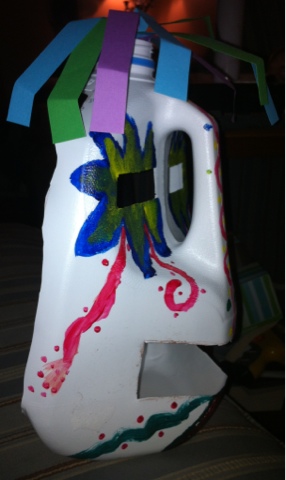
Here is my completed mask:



Fancy Coconut Mask of Puerto Rico
Media: painted coconut husk and carved wood spikes
Artist : unknown
Date: unknown
Description: Brightly painted coconut husk, Eleven skinny long spikes arranged around the face of the mask.
Formal Analysis: This piece uses the element of pattern, the pattern is not only on the face but is carried through to the spikes.

Blue Moon Mask
Media: carved and painted wood
Artist: Unknown
Date: Unknown
Size: 8 inches
Description: This brightly painted mask from Mexico uses vivid colors, predominately the blue to indicate a night sky full of stars.
Formal Analysis: This mask uses color as its main element of art and also utilizes texture in the carving on the wood. Another element used was that of stippling, this creates the effect of stars.

Columbian Mask
Media: Carved and painted wood
Artist: unknown
Date: unknown
Size: 9 inches
Description: Carved and then painted wooden mask, bright colors used, two small holes used as eye holes.
Formal Analysis: Texture is added to the top of the mask to create the look of hair. The variety of pattern and color are elements used.
In looking up different masks I found this picture and that's where I have come up with the idea to use a milk carton as the base for my mask.
Here are the sketches I came up with for my mask:

Here is my completed mask:
The elements of design I used are color, I used a contrasting color scheme, line, the lines on the nose and at the bottom of the mask create movement. I also used strips of paper at the top to create texture to the mask and also serves as hair.
I'm quite happy with how my mask turned out. Using a gallon milk jug helped me to create the three dimensional quality for this mask. I found the process of research to be the hardest part of this process but also helpful. Had I not come across the picture of the milk jug I would have had a much harder time creating a three dimensional mask. I can't wait to see what my classmates did for their own masks.
Mod 10 Videos Blog
I chose these two videos as my selections:
African Art: A Legacy of Oppression
The Great Wave
1. Explain why you selected each of the TWO videos you choose from the selection listed above.
I selected the African Art: A legacy of Oppression because the title intrigued me as well as the description of the video. I chose The Great Wave because I have admired this painting and was interested in learning more about its background
2. For each video list/discuss the key concepts you learned.
A key concept I learned from the African Art video was that much of the art we see as western art has roots in African Art, in particular the minimalist abstract. Another key concept was how terribly the African people were treated and then even displayed as art to "enrich" the western society about the African people and lands.
A key concept I learned from The Great Wave video was the making of a print. I didn't realize that you needed to make a separate woodblock relief for each color that will be in the print. I found this portion of the video most informative. What a tedious process this is.
3. How do the videos relate to the readings in the text?
The African art video relates to the African art section of the text in chapter 18 and helped me to understand the ideals behind their art.
The Great Wave video related to the previous chapter on prints and in chapter 19's description of Japanese art.
4. What is your opinion of the films? How do they add depth to understanding of the readings and art concepts?
I felt the African video was done very well, full of information and was only 21 minutes long. This video helped me to gain a better knowledge as to how the art came to the western world, as horrifying as it is to think about.
The Great Wave was an interesting video and helped me to better grasp the concepts of prints and editions of prints.
African Art: A Legacy of Oppression
The Great Wave
1. Explain why you selected each of the TWO videos you choose from the selection listed above.
I selected the African Art: A legacy of Oppression because the title intrigued me as well as the description of the video. I chose The Great Wave because I have admired this painting and was interested in learning more about its background
2. For each video list/discuss the key concepts you learned.
A key concept I learned from the African Art video was that much of the art we see as western art has roots in African Art, in particular the minimalist abstract. Another key concept was how terribly the African people were treated and then even displayed as art to "enrich" the western society about the African people and lands.
A key concept I learned from The Great Wave video was the making of a print. I didn't realize that you needed to make a separate woodblock relief for each color that will be in the print. I found this portion of the video most informative. What a tedious process this is.
3. How do the videos relate to the readings in the text?
The African art video relates to the African art section of the text in chapter 18 and helped me to understand the ideals behind their art.
The Great Wave video related to the previous chapter on prints and in chapter 19's description of Japanese art.
4. What is your opinion of the films? How do they add depth to understanding of the readings and art concepts?
I felt the African video was done very well, full of information and was only 21 minutes long. This video helped me to gain a better knowledge as to how the art came to the western world, as horrifying as it is to think about.
The Great Wave was an interesting video and helped me to better grasp the concepts of prints and editions of prints.
Mod 9 Videos Blog
For this week's module I chose the below videos:
Leonardo da Vinci: The Mind of the Renaissance
Velazquez
1. Explain why you selected each of the TWO videos you choose from the selection listed above.
I selected these two videos based on the descriptions of the videos on the link and because I was interested in learning more about Leonardo da Vinci. I chose the video about Velazquez because I was unfamiliar with his work.
2. For each video list/discuss the key concepts you learned.
The key concept I learned from the Leonardo da Vinci was just how vast his talents were. Not only as an artist but as a scientist, an architect, and engineer. He was an innovator almost from childbirth. As a young child he was always trying to learn more and even started inventing new ways to do everyday activities like reading. He became so talented that his mentor Veraccio stopped creating art after seeing da Vinci develop.
The key concept I learned from the Velazquez video was how he was able to balance the humanity of the figures while still depicting them as a "jester" or a character. He did this skillfully through his use of color, the use of subtle and bold together and also in the way in which he painted their faces as distorted and lacking light suggesting that they were dim witted.
2. How do the videos relate to the readings in the text?
Both videos expand the knowledge of each artist. The text does talk about and showcase each of these two artists but the videos give you a more detailed understanding of each artists life.
3. What is your opinion of the films? How do they add depth to understanding of the readings and art concepts?
I found both films interesting, particularly the video on da Vinci; I found his life fascinating. The description of his use of hatching gave me a better understanding of that art concept, it was helpful to see the drawing as the description was explained. In the Velazquez video I found the description on his use of simple coloring as opposed to rich and vibrant colors to get his point across helpful in better understanding of the use of colors.
Leonardo da Vinci: The Mind of the Renaissance
Velazquez
1. Explain why you selected each of the TWO videos you choose from the selection listed above.
I selected these two videos based on the descriptions of the videos on the link and because I was interested in learning more about Leonardo da Vinci. I chose the video about Velazquez because I was unfamiliar with his work.
2. For each video list/discuss the key concepts you learned.
The key concept I learned from the Leonardo da Vinci was just how vast his talents were. Not only as an artist but as a scientist, an architect, and engineer. He was an innovator almost from childbirth. As a young child he was always trying to learn more and even started inventing new ways to do everyday activities like reading. He became so talented that his mentor Veraccio stopped creating art after seeing da Vinci develop.
The key concept I learned from the Velazquez video was how he was able to balance the humanity of the figures while still depicting them as a "jester" or a character. He did this skillfully through his use of color, the use of subtle and bold together and also in the way in which he painted their faces as distorted and lacking light suggesting that they were dim witted.
2. How do the videos relate to the readings in the text?
Both videos expand the knowledge of each artist. The text does talk about and showcase each of these two artists but the videos give you a more detailed understanding of each artists life.
3. What is your opinion of the films? How do they add depth to understanding of the readings and art concepts?
I found both films interesting, particularly the video on da Vinci; I found his life fascinating. The description of his use of hatching gave me a better understanding of that art concept, it was helpful to see the drawing as the description was explained. In the Velazquez video I found the description on his use of simple coloring as opposed to rich and vibrant colors to get his point across helpful in better understanding of the use of colors.
Wednesday, July 17, 2013
Art Making/Material Exploration: Exploring Line
This week we have been asked to create a drawing of our hands using our dominant and non dominant hands. My dominant hand is my right hand, my drawing of the left hand was used with my right hand. The drawing of my right hand was drawn using my left hand. Here is how it turned out. 
I found it easier than I had anticipated to use hands as subject for my drawing. I am still very nervous about drawing, it seems to be a hurdle I will never overcome. I worked myself up so much that as I began my right hand was shaking. As my hand drawing developed I was able to relax and go with it. I used graphite pencils to create my drawing. I used pencils because that's all I have and its what I'm most familiar with. I have never used charcoal. It was very unusual to create a drawing with my non-dominant left hand. My left hand was shaking a lot and I found it very hard to create straight lines. The drawing of my right hand is much skinnier than my left hand. It also has much less detail. It was difficult to create detail using my left hand. I do feel though that both hands ended up as successful examples of hands. I do think I will use my left hand more often when I'm drawing, I would be interested to see if I could develop the skill of drawing with left hand.
Wednesday, July 10, 2013
Mod 8 Video Blog
This week I watched:
More Human than Human
Cataclysm: The Black Death Visits Tuscany
1. Explain why you selected each of the two videos you choose from the selection listed above.
We were asked to watch More Human than Human and then to pick one additional video. I chose Cataclysm: The Black Death Visits Tuscany because it seemed to be the most interesting based on the descriptions of the videos.
2. For each video list/discuss the key concepts you learned.
In More Human than Human, the key concepts are learned were to expand the discussion on the baby Herring gulls and their reaction to the stick with a line(s) drawn on them, this was previously discussed by the same scientist in a previous video we had watched this semester. I also found the concept of culture effecting the depictions of the human body in the art world. In early times certain elements of the human female figure was grossly exaggerated, while other body parts were completely downplayed. Then as society and culture changed so did the depictions of the human form, to those of the Egyptians, which were all very similar and all had the same scale. Once again as the culture changed so too did the human depictions in sculpture, to once again exaggerating the parts they wanted to emphasize to showcase their strength as the Greek statues did.
In Cataclysm, the key concepts I took were the profound effect the Bubonic Plaque had on the cities of Sienna and Florence in Italy. Not only did it have a huge death toll but it also effected pretty much every level of life in the region. The plaque spared no one, rich, poor, clergy, sinner. This caused the virtual stoppage of life as they knew it. Life was now filled with pain, suffering and riches were lost. Another key concept I took was the cyclic nature of development throughout the centuries. While many historians originally stated that the decline of the arts and development in the second half of the 14th century was due to the plaque, now it is more likely that this was simply due to the cyclical nature of development and then lulls in development and innovation. This can be documented on many centuries throughout history. The century usually begins with a high level of innovation, new developments. The second half of the century tends to lag behind and not many new developments come to fruition.
2. How do the videos relate to the readings in the text?
More Human than Human expands on the Paleolithic era art, describing in more detail the Venus of Willendorf. The Cataclysm video expands our knowledge of the Italian artists of the 14th century and their innovations to painting. Duccio and Giotto had a great impact on the beginning of the Renaissance period.
3. What is your opinion of the films? How do they add depth to understanding of the readings and art concepts?
I enjoyed both videos and felt they were both excellent in helping my knowledge of the chapters of text that this accompanied. The information was presented well and held my interest throughout both videos.
More Human than Human
Cataclysm: The Black Death Visits Tuscany
1. Explain why you selected each of the two videos you choose from the selection listed above.
We were asked to watch More Human than Human and then to pick one additional video. I chose Cataclysm: The Black Death Visits Tuscany because it seemed to be the most interesting based on the descriptions of the videos.
2. For each video list/discuss the key concepts you learned.
In More Human than Human, the key concepts are learned were to expand the discussion on the baby Herring gulls and their reaction to the stick with a line(s) drawn on them, this was previously discussed by the same scientist in a previous video we had watched this semester. I also found the concept of culture effecting the depictions of the human body in the art world. In early times certain elements of the human female figure was grossly exaggerated, while other body parts were completely downplayed. Then as society and culture changed so did the depictions of the human form, to those of the Egyptians, which were all very similar and all had the same scale. Once again as the culture changed so too did the human depictions in sculpture, to once again exaggerating the parts they wanted to emphasize to showcase their strength as the Greek statues did.
In Cataclysm, the key concepts I took were the profound effect the Bubonic Plaque had on the cities of Sienna and Florence in Italy. Not only did it have a huge death toll but it also effected pretty much every level of life in the region. The plaque spared no one, rich, poor, clergy, sinner. This caused the virtual stoppage of life as they knew it. Life was now filled with pain, suffering and riches were lost. Another key concept I took was the cyclic nature of development throughout the centuries. While many historians originally stated that the decline of the arts and development in the second half of the 14th century was due to the plaque, now it is more likely that this was simply due to the cyclical nature of development and then lulls in development and innovation. This can be documented on many centuries throughout history. The century usually begins with a high level of innovation, new developments. The second half of the century tends to lag behind and not many new developments come to fruition.
2. How do the videos relate to the readings in the text?
More Human than Human expands on the Paleolithic era art, describing in more detail the Venus of Willendorf. The Cataclysm video expands our knowledge of the Italian artists of the 14th century and their innovations to painting. Duccio and Giotto had a great impact on the beginning of the Renaissance period.
3. What is your opinion of the films? How do they add depth to understanding of the readings and art concepts?
I enjoyed both videos and felt they were both excellent in helping my knowledge of the chapters of text that this accompanied. The information was presented well and held my interest throughout both videos.
Subscribe to:
Posts (Atom)